Silicone parts are used across many industries because they can handle heat, flexibility, compression, chemicals, and repeated use better than many traditional thermoplastics. From seals and gaskets to medical components, electronics protection, wearable products, and industrial pads, liquid silicone rubber parts are often small, precise, and performance-critical.
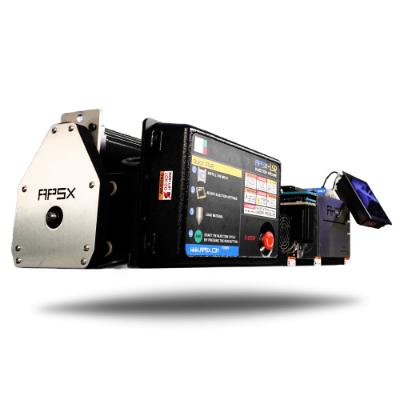
The challenge is that traditional LSR injection molding equipment is usually expensive, large, and complex. For many silicone part makers, this creates a gap between prototyping and full-scale production. A company may need 50, 500, or 5,000 parts, but not enough volume to justify a large industrial LSR molding cell. That is where a portable all-in-one machine like the APSX-LSR silicone injection molding machine becomes useful.
A Practical Tool for Low-Volume LSR Production
Not every silicone part requires high-volume production. Many industrial applications start with small batches: product testing, customer samples, pilot runs, bridge production, replacement parts, or custom components. Sending these jobs to a large molding supplier can be expensive and slow, especially when the design is still changing.
A compact LSR injection molding machine gives silicone part makers more control. Instead of waiting weeks for outside sampling, they can test a mold, adjust the part design, change material hardness, and run small batches in-house. This shortens the development cycle and helps companies respond faster to customer needs.
For small and mid-size manufacturers, speed is often more valuable than maximum output. The ability to mold a small batch today can help win a customer, validate a design, or solve a production problem without waiting for a full-scale supplier.
Useful for Industrial Applications
APSX-LSR is especially relevant for silicone parts used in industrial and technical applications, including:
- Seals and gaskets
- Vibration pads and dampers
- Medical and dental components
- Sensor covers and protective encapsulation
- Electrical insulation parts
- Soft-touch grips and buttons
- Wearable device components
- Automotive and aerospace prototypes
- Fluid handling components
- Custom molded silicone parts for machinery and equipment
Many of these parts are small, functional, and made in limited quantities before they move to larger production. A portable LSR machine allows companies to prove the application before investing in expensive production tooling or outsourcing large quantities.
Better Control Over Material and Process
Silicone molding is not only about shape. The final part performance depends on material selection, mixing, injection, mold temperature, cure time, and part design. When all development is outsourced, the silicone part maker may have limited visibility into the process.
An in-house LSR machine allows teams to learn the relationship between material, mold, and finished part. They can test different durometers, part geometries, venting strategies, and cure conditions. This is valuable for engineers, mold makers, R&D teams, and manufacturers who need to understand the process before scaling.
For companies that already make silicone parts, APSX-LSR can become a development and sampling machine. For companies that are new to LSR, it can be an accessible entry point into silicone injection molding.
Reducing Dependence on Large Production Equipment
Traditional industrial LSR systems often require significant floor space, auxiliary equipment, setup time, and technical support. That makes sense for high-volume production, but it may not be practical for every job.
A portable all-in-one LSR machine helps reduce that barrier. It can be used for short runs, mold trials, application testing, customer demonstrations, and internal product development. This gives companies more flexibility without committing to a large production cell before the demand is proven.
For mold makers, this can also be valuable. A mold shop can test small LSR molds, validate part quality, and support customers with sampling before sending the project to a larger production environment.
A Bridge Between Prototype and Production
Many silicone products begin with hand-cast samples, 3D-printed molds, or machined prototypes. These methods are useful, but they do not always represent the final molded part. Injection-molded LSR gives a more realistic picture of part quality, repeatability, surface finish, and production behavior.
APSX-LSR can help bridge the gap between early prototyping and industrial-scale molding. This is useful when a company needs real molded parts for testing, certification, customer evaluation, or limited sales.
Why It Matters
The market for silicone parts continues to expand because industries need flexible, durable, and high-performance components. However, many companies still struggle with the cost and complexity of getting started with LSR injection molding.
A portable all-in-one APSX-LSR machine gives silicone part makers a practical way to bring development, sampling, and low-volume production in-house. It supports faster iteration, better process understanding, lower outsourcing dependence, and more control over small-batch production.
For companies producing industrial silicone parts, APSX-LSR is not meant to replace every large production machine. It is designed to fill an important gap: making LSR injection molding more accessible, flexible, and practical for the jobs that do not require a full industrial molding cell.