
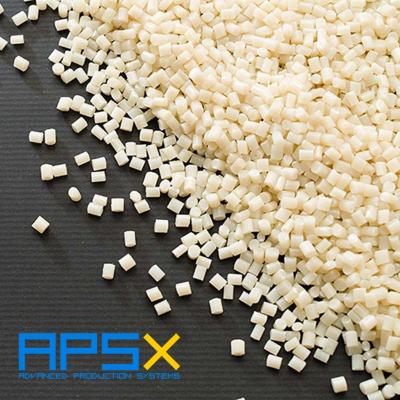
When troubleshooting injection molding, most people first look at the mold, temperature, pressure, injection speed, cooling time, or material grade. Those are all important. But there is another detail that is easy to overlook:
The plastic pellets going into the machine.
Pellet size and shape can directly affect how consistently the plastic melts. If the material does not melt uniformly, the molded parts will not be uniform either. This matters in all injection molding, including small-batch, prototyping, education, and low-volume production with the APSX-PIM.
The APSX-PIM gives users an affordable and compact way to bring injection molding in-house. But like every injection molding process, good results still begin with good material preparation.
The Pellet Is the Starting Point
Injection molding starts before the plastic reaches the mold. It starts in the hopper.
Plastic pellets travel from the hopper into the feed throat, then into the barrel, where they are heated, compacted, melted, and injected into the mold cavity. For this process to be stable, the pellets should be as consistent as possible.
That means:
- similar size
- similar shape
- clean material
- dry material
- minimal dust and fines
- no large chunks or streamers
- no contamination
- no unknown mixed plastics
If pellets are inconsistent, they may not melt at the same rate. Small particles can melt too early. Large chunks can melt too late. Irregular shapes can feed unevenly. The result is unstable melt quality.
And unstable melt quality creates unstable molded parts.
Why Uniform Melting Matters
In injection molding, the goal is not just to make plastic hot. The goal is to create a uniform melt at the correct processing temperature.
If some pellets are fully melted while others are only partially melted, the material entering the mold will not behave consistently. This can cause cosmetic defects, dimensional variation, weak parts, and process instability.
Common problems from non-uniform melting include:
- short shots
- splay
- bubbles
- black specks
- white specks
- unmelted particles
- color streaks
- inconsistent part weight
- poor surface finish
- weak or brittle areas
- cycle-to-cycle variation
This is why material consistency is so important. A good machine and a good mold cannot fully compensate for poorly prepared material.
The Problem with Fines
Fines are very small plastic particles, dust, or powder-like material that may be mixed in with pellets or regrind.
Fines create a problem because they melt much faster than normal pellets. When fines melt too early, they can reduce the friction needed to properly melt the rest of the material. This can leave normal-size pellets partially unmelted.
That can lead to specks, splay, inconsistent melt, or poor part quality.
For APSX-PIM users, this is especially important when using regrind. If the regrind contains too much dust or very small particles, the process may become harder to control.
The Problem with Oversized Pellets or Chunks
Large pellets or chunks create the opposite problem. They may not melt fast enough.
Oversized particles can also interfere with feeding. This can reduce how consistently the machine prepares the next shot of plastic.
Possible results include:
- inconsistent shot size
- short shots
- bubbles
- splay
- unmelted material
- unstable injection behavior
This is one reason why regrind should be controlled carefully. Large chunks, long strands, or irregular pieces should not be treated the same as uniform virgin pellets.
Regrind Can Be Useful, But It Must Be Controlled
One advantage of in-house injection molding is the ability to experiment, iterate, and reduce waste. Regrind can sometimes be part of that process.
However, regrind is not automatically equal to virgin material.
Regrind may contain:
- fines
- large chunks
- long streamers
- irregular flakes
- degraded resin
- mixed materials
- moisture
- contamination
Any of these can change the way the material feeds, melts, and fills the mold.
A better approach is to first establish a stable process with virgin material. Once the mold, temperature, injection volume, and cycle are understood, then a controlled amount of clean regrind can be tested.
Do not start troubleshooting a new mold with unknown or poor-quality regrind. That adds too many variables at once.
Moisture and Air Can Look Like Material Problems
The article also points out an important issue: air between compacted pellets needs to escape during processing. If material starts melting too early in the wrong section of the barrel, air can become trapped and travel forward with the melt.
That trapped air can show up as splay or bubbles in the molded part.
This is important because splay is often blamed only on moisture. Moisture can absolutely cause splay, especially with materials like nylon, polycarbonate, PET, and other moisture-sensitive resins. But trapped air, volatiles, poor feeding, or non-uniform melting can create similar symptoms.
For APSX-PIM users, the practical lesson is:
Do not assume every visual defect is caused by one setting. Check the material condition first.
Why This Matters for APSX-PIM Users
The APSX-PIM is often used for:
- product development
- prototype parts
- short-run production
- university and technical training
- R&D testing
- small business manufacturing
- mold design validation
- material trials
In these applications, users are often changing molds, changing materials, adjusting parameters, and learning from each shot. That flexibility is one of the biggest advantages of a desktop injection molding machine.
But fast iteration only works when the process is controlled.
If the pellet size, shape, dryness, or cleanliness changes from run to run, the user may think the problem is the mold or the machine setting. In reality, the problem may be the material going into the hopper.
Consistent pellets make it easier to identify the real cause of a molding issue.
Practical Material Tips for APSX-PIM
Here are simple guidelines for better results:
1. Start with virgin pellets
When testing a new mold or learning a new material, use clean virgin pellets first. This removes regrind variation from the process.
2. Avoid dusty material
Dust and fines can melt too early and disrupt the melting process. Keep material clean.
3. Watch for oversized chunks
Do not use regrind with large pieces, long strands, or irregular chunks unless it is properly granulated and screened.
4. Keep material dry
Store pellets in sealed containers. Dry moisture-sensitive materials according to the resin supplier’s recommendations.
5. Do not mix unknown plastics
Different plastics have different melt temperatures, shrink rates, viscosities, and processing windows. Unknown blends are difficult to troubleshoot.
6. Use regrind gradually
After the process is stable with virgin resin, test regrind in a controlled percentage. Keep notes on how much regrind was used.
7. Record your material information
Track the resin type, grade, supplier, melt flow rate, drying time, drying temperature, colorant, and regrind percentage.
8. Troubleshoot material before changing everything else
If parts suddenly show splay, bubbles, specks, shorts, or inconsistent fill, check the pellets before making major mold or machine changes.
Good Parts Start with Good Material
Injection molding is a system. The machine, mold, material, and process settings all work together.
The APSX-PIM makes injection molding more accessible for small shops, engineers, educators, and product developers. It reduces the need for large industrial machines when the goal is prototyping, short-run production, or faster iteration.
But the material still matters.
Uniform pellets help create a uniform melt. A uniform melt helps create consistent molded parts. Clean, dry, properly sized pellets make the entire process easier to control.
Final Takeaway
Pellet size and shape may seem like a small detail, but they can have a large effect on injection molding results.
For APSX-PIM users, the recommendation is straightforward:
Use clean, dry, uniform pellets whenever possible. Be careful with regrind. Avoid fines, dust, oversized chunks, and unknown mixed materials.
Before blaming the mold, the machine, or the settings, look at the material going into the hopper. Many molding problems begin there.